
Collector’s Spotlight: An Early Meissen Tea Caddy Before Meissen, true porcelain was one of the great mysteries of Europe.
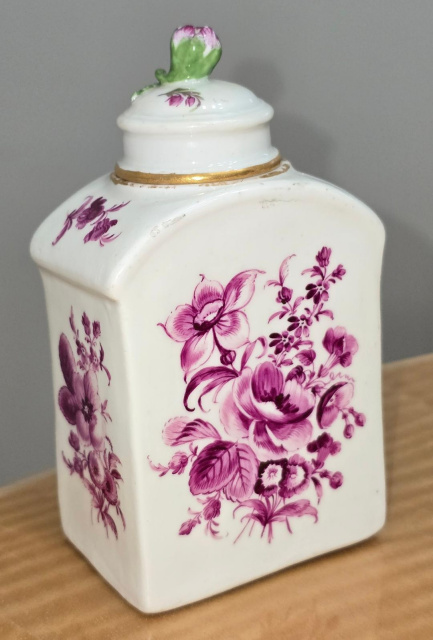
For centuries it came only from China and Japan, imported at enormous cost and often called “white gold.” European courts collected it obsessively, but no one knew how it was made. That changed in the early 1700s when, under the patronage of Augustus the Strong in Saxony, the secret was finally discovered. Meissen became the first factory in Europe to produce true hard-paste porcelain, and in doing so it transformed the history of ceramics. Because Meissen was first, everything from this early period carries special importance. These were not simply decorative objects. They were technological breakthroughs and luxury items for the elite. This tea caddy dates to the mid-18th century, a time when both porcelain and tea were still symbols of wealth and refinement. Tea itself was expensive, stored carefully, and often kept under lock and key. The container mattered just as much as the contents. The hand-painted decoration seen here in manganese purple, known as Purpurmalerei, is one of the classic enamel palettes of the period. Each side was painted individually and entirely by hand, well before any form of transfer decoration existed. Collectors look for several things in early Meissen: • The soft, slightly uneven underglaze crossed swords mark • An unglazed or “bisque” base showing the original firing surface • The sculptural quality of the form • Enamel work that has depth rather than a flat printed look Tea caddies form a collecting category of their own. Many were separated from their original lids over the centuries, and genuine 18th-century examples with their covers still intact are becoming increasingly difficult to find. Today Meissen is still in operation as the oldest porcelain factory in Europe and remains a benchmark for quality. Yet the earliest pieces continue to stand apart because they represent the moment Europe first mastered porcelain. Holding one is less about owning a container and more about holding a piece of that discovery. Melrose Treasures Estate Sales of Los Angeles